For Parents & Coaches of (12 –18) Year Old Athletes Who Already Know Deep Down That the Current System Is Quietly Destroying Their Kid's Body, Mind, and Love for the Game
🤫 The Youth Sports Arms Race Is All One Big Lie & The Data Proves It's Actually Sabotaging Your Teens Future.
Discover the evidence-based protocol that elite NFL pros, Olympic champions, and sports scientists use: doing less of one thing creates tougher, more resilient, injury-resistant athletes who perform at higher levels for longer — without the burnout, overuse injuries, anxiety spirals, or family tension you're seeing right now.
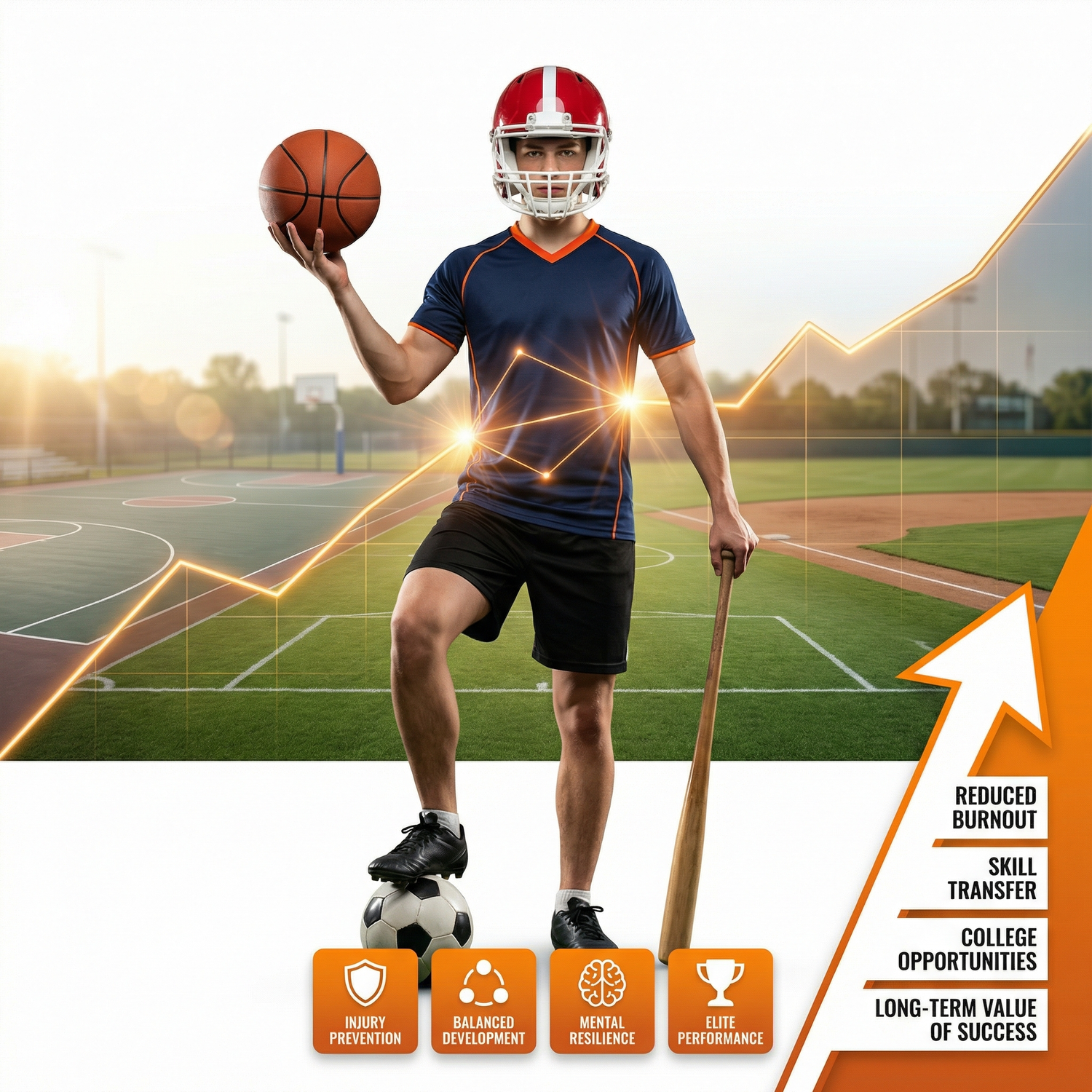
This is a strategic, evidence-based blueprint that shows you exactly why the multisport path produces tougher, healthier, longer-lasting athletes — and gives you a practical roadmap to pivot your teen toward sustainable success.
 Get Instant Access — $27
You signed up for resilience, teamwork, discipline, joy.
Instead, the system is handing you fragile, overtrained, anxious kids who might quit forever.
The myth they've sold you — This is what it takes to compete — is costing your teen their health and happiness.
It's time to expose the lie and flip the script.
(Instant PDF Download + All Bonuses – Secure Checkout – Risk-Free)
Stop picturing another season of silent car rides, mystery limps, and a kid who’s already mentally checked out by mid-year.
Picture this instead — the real protocol in action:
Your teen walks through the door after practice actually lit up — replaying a sick crossover, a nasty takedown, a PR lift, laughing about a teammate’s screw-up, already talking trash about beating their own time tomorrow.
The random aches and “tweaks” that used to linger for weeks? Gone. Different planes of motion, different loading patterns, different recovery demands — the body finally gets what it’s been begging for, so it stops breaking down.
The pre-game stomach knots and “what if I choke” spiral? Replaced with clean, focused adrenaline — confidence that doesn’t shatter on one bad play because it’s built on a foundation of multiple skills, multiple identities, multiple wins.
Car rides home flip from interrogation to actual conversation. You drop “I love watching you play” and it lands — no tension, no hidden critique, no guilt trip disguised as feedback.
They believe you. They feel it.
Sleep score jumps from 6.8 wrecked hours to 8–9+ restorative ones. Grades stop tanking. Friends outside the team start showing up again. They’re not just an athlete anymore — they’re a full, resilient human who happens to be damn good at sports.
And the part most parents never see coming:
Their performance in the primary sport actually climbs.
Wider movement library = better athletic IQ.
Mental freshness from cross-training = sharper focus under pressure.
Intrinsic fire from real enjoyment = deeper work ethic.
All of it compounds into an athlete who’s not only healthier and happier — but legitimately more competitive at the levels that matter.
This isn’t wishful thinking.
This is what happens when you run the correct protocol instead of the broken one.Your family doesn’t have to keep living the slow bleed version.
The balanced, high-output version is one decision away.
Instant PDF download + bonus Quick Pivot Checklist. Secure checkout.
Organizations We Have Worked With



 The Backstory
My name is Coach Timbo.
And if you caught me on the sidelines or in the weight room a couple years back…
You’d see a coach quietly burning out right alongside the kids—running endless drills, fielding parent calls about more reps or college exposure, watching talented athletes limp off with overuse injuries, and dealing with the fallout when burnout hit: mood swings, lost motivation, kids quitting the sport they used to live for.
I was deep in it:
Year-round specialization demands from travel teams and recruiters
Teens tying their entire identity to one position, one sport—then crumbling if they got cut or hurt
Parents pushing hard out of love, but accidentally turning practice into pressure cookers
That sinking feeling every time another kid walked away mid-season, confidence shot and joy gone
I hit my limit when I saw too many good athletes—some in my own program—hit the wall: overuse injuries stacking up, mental toughness fading, and the fun evaporating. I couldn't keep coaching the same old way.
I dug into the real evidence: Ryzer data showing a 15% drop in grit, confidence, and decisiveness among young athletes; NFL studies proving multisport guys have fewer injuries and longer careers (12+ more games, 0.7 extra years on average); AAP guidelines screaming to delay specialization until late adolescence; and stories of elite pros who sampled everything and came out tougher.
So I decided to build a different system.
The Multisport Advantage.
The next few seasons changed everything.
My athletes started switching sports or cross-training more—staying injury-free longer, sleeping better, showing up with real fire instead of obligation.
Parents stopped the post-game interrogations and started saying I love watching you play.
Kids built broader skills, bounced back from setbacks faster, and—most importantly—rediscovered why they loved competing in the first place.
Dropout rates in my groups dropped, confidence soared across activities, and we were developing resilient young men and women, not fragile specialists.
Now? I'm helping other coaches and parents do the same.
We can both agree teens need to be staying in sports longer for a handful of reasons like...
Avoiding the injury cliff, rebuilding intrinsic drive, and actually enjoying the ride again—without sacrificing their shot at elite levels.
I turned this battle-tested system into a dead-simple guide anyone can follow.
A strategic playbook—backed by the data and real-field results—that proves doing less of one thing leads to winning at everything.
Instant PDF download + bonus Quick Pivot Checklist. Secure checkout.
What You’ll Get Inside: The Multisport Advantage: Why Doing Less of One Thing Leads to Winning at Everything
The Complete Multisport Advantage Blueprint PDF — The complete strategic playbook: data, myths busted, psychology explained, physiology fixes, and step-by-step pivot plan ($97 value)
Quick Pivot Checklist (Printable 1-Pager) — One-page roadmap: investment years, 3-month rest blocks, success redefinition, language shifts ($27 value)
Parent/Coach Scripts Pack — 10+ ready phrases to kill pressure and rebuild intrinsic drive ($27 value)
Burnout & Recovery Tracker (printable journal) — Weekly log for sleep, fun, soreness, mood—catch issues early ($17 value)
Total Value: $205+
Launch Price Today: Just $27 One-Time

P.S. One more season of the same grind could cost you thousands more in medical bills, lost time, and a kid who walks away forever. $27 today to help protect everything you've already invested — and gives your athlete the real edge they deserve.
"We Were One Season Away From Quitting.
NOW HE'S STARTING VARSTIY"
See what happens when parents stop guessing and start using the Protocol.
"The 'Car Ride' Contract Saved Our Relationship."
★★★★★
"I didn't realize I was the problem. I thought I was 'coaching' him on the ride home, but the Parental Pressure Audit showed I was actually killing his drive. We implemented the 'Silent Sidelines' contract immediately. The first week was hard (for me!), but the change in his demeanor was instant. He’s smiling again. He’s playing loose. And ironically, now that I’ve stopped coaching, he’s playing the best soccer of his life."

Mark T., Father of a U14 Soccer Player (Dallas, TX)
"Cheaper Than One Hour of Therapy."
★★★★★
"We were spending over $6,000 a year on travel ball, but my son was anxious and losing confidence. Spending only $27 on this system seemed like a drop in the bucket, but it has been one of, if not the highest ROI investment we’ve made. The Parent/Coach Scripts were super helpful and gave us all of the exact words to say to rebuild his confidence without adding pressure. He’s enjoying the game again, which is all we ever wanted."

Jessica L., Mother of a 12-year-old Basketball Player
"We Fixed the 'Identity' Crisis Before It Happened."
★★★★★
"My son used to say 'I am a hockey player.' If he lost, he was miserable for days. The Multisport Advantage Blueprint opened my eyes to 'Identity Foreclosure'. We used the 'Identity Pie' Worksheet to help him see he is also a musician and a student. Last weekend he played a terrible game, but instead of shutting down, he shook it off and went to play guitar. That mental resilience is priceless."

David P., Entrepreneur & Sports Dad (San Jose, CA)
❌ You are at a crossroads. ❌
It’s Time to Make a Managerial Decision.
Path A: You keep doing what you are doing.
You keep writing the checks for travel teams. You keep hoping the anxiety goes away. You keep crossing your fingers that the grind doesn't result in a burnout statistic or a stress fracture.
Result: You’re gambling your teen’s body, mind, and love for the game against 0.011% odds (the real D1 success rate in most sports). The system is built to break more kids than it builds — and you’re still playing by its rules.
Path B: Take control right now.
Download The Multisport Advantage. Run the protocol. Fix the sleep deficit. Diversify their identity so one bad game or injury doesn’t shatter them. Arm them with the mental and physical tools pros actually use — not the myths sold to parents.
Result: You build a bulletproof athlete who loves the game again, stays injury-resistant, performs better long-term, and lasts long enough to actually win — on the field and in life.
You are the General Manager. The ball is in your court. The season is ticking.
One more week, one more month in the old system could cost thousands more in medical bills, lost joy, and a kid who walks away forever.
This decision is $27.
Less than one private lesson.
Less than a quarter of a tournament entry fee.
Less than the gas money for the next away game.
Normally $47.
Today: Just $27 One-Time
(Instant PDF Download + All Bonuses – Secure Checkout – Risk-Free)